Tuesday, 4 October 2016

A Photographic Update

So I've finally sat down and decide to write a blog post.

Instead of boring you with excuses I'll try and bring you all up to date with the year with some pictures!

 As you know the year started with a horrible cold spring.
Here we are vaccinating R2s in the sleet!

 Because our old sheds couldn't cope with the rainfall, we turfed the calves out early. They had a tough start but are now thriving.

Not the most exciting photo, but you can see the damage done to our paddocks in the spring.

As soon as conditions improved we set about repairing the damage. Trashed paddocks had new grass oversown and our tracks were earmarked for resurfacing. We took the opportunity to widen the track above which leads to our furthest paddocks.

 Once May arrived the heat and warmth really kicked in. May-September we only recorded two weeks growing less than 70kgDM/Ha. To counter this and avoid cutting mountains of silage we set about premowing. Every paddock had to be mowed twice to stop the grass heading!

Here are the bull teams getting ready for action! We cut the AI period to 4 weeks this year. We recorded 90% cycling in the first 3 weeks. Scanning results have been excellent: 90% in calf in 6 weeks with only 5% empty after 12 weeks.

We were very fortunate to source second hand astrotruf to cover our tracks. First we graded them out by patching and rolling any holes, then unrolled astroturf to create a very soft cow friendly sruface. Check out the video here: https://goo.gl/photos/VHWM1LZ7EmXswTh39

 View of the herd ready to be milked. Typically we'd get 3 months unsupplemented production. This year it will be 4.5.

 Heading into the autumn covers rose without much effort. Clover had been particularly prominent in our swards which is great for milk production.

 Just like the cows, our calves have been unsupplemented since May and look very content on grass.

A final shot of us rolling out astroturf. A lot of the work we have carried out this year has really been dictated to us by the weather!

I hope this gives you an idea of what we've been up to. Normal, more detailed blog posts will be coming soon.
Until then, there should be plenty of grass on UK farms so there's no excuse to not keep grazing!

Thursday, 7 April 2016

Focussing On The Important Things

A fine view of the Clwydian Range from the runoff block

Well, here we are in April, and spring still hasn't arrived. Growth has been slow, averaging 15-30kgDM/Ha/Day. Looking back at last year, during the same period we recorded 55kg growth. This is a huge difference on a highly stocked farm such as ours. Instead of pregrazing at 2600+, we're going into 2100. Cows are on a 30 day round with 4.5kg concentrates and 4-5kgDM of silage. The same period last year there was no silage in the diet and we had started taking the concentrates out too. Fortunately milk yield is fairly steady at 2-2.2kgMS a day, but with the low energy density of the silage, milk proteins are low at 3.3%.

On the calving front we've sold a lot of late calvers and some empties we fattened overwinter. We're still calving 1-2 a day, with 10 needed to make a nice herd of 400 cows. We did consider milking more and stocking over 4 cows/Ha, but given the slow spring and low payout, instead we're happy to just consolidate the herd with earlier calvers.

Cows are spending up to 6 hours a day stood on the feedpad

But hey, if I wanted to moan about milk price and weather I'd spend a day at the local market!
Instead I want to talk about decision making in farming systems.

For me there is always a tension in farming between doing what we believe will generate a return, and doing what we want to do, to preserve out own enjoyment and sanity! This first practise I will call "margin chasing" and the second I will call "lifestyle". To make this clearer I'll list and categorise some farming choices and practises which I've had to make decisions around:

Margin Chasing
Rearing bull calves
Using beef bulls
Winter milking
Split autumn and spring calving
Milk recording
In house contracting work
Using less labour
More vaccination
High levels of reseeding and cropping
Rearing and selling surplus heifers
Long AI period
High breeding intervention
Complex cow diets
Animal focussed advise

Lifestyle
Once a day milking
A large milking parlour
More labour
Contracting out all tractor work
Taking more holidays
More family time
Lax record keeping
No vaccination
No reseeding
No AI
No intervention

Be aware that this list relates only to myself and my own farm! I am NOT arguing that OAD milking has no margin or that high reseeding levels do! These are ideas I've considered and how I have chosen to categorise them in my on mind.

The key is always to strike a balance on your own farm. You could draw up and categorise a similar list for different farmers and you could guarantee that no two would be the same. Unfortunately in times of low prices farmers are forced or advised further down the Margin Chasing route putting at risk their own personal health. Before we take any decision or embark on a change of practise we have to ask what is driving that decision? Will the outcomes be positive for both business profitability and our own enjoyment and health?

This tension between profit and lifestyle is a topic I'd like to return to in the future.
But until then let's look forward to some improved weather and for a lot of us, finishing calving!

Wednesday, 2 March 2016

Wet Wet Wet

Just a quick post. It's been a wet February and it looks to be a cold AND wet March. Every break is back fenced with cows grazing 3-4 hours during the day then stood on silage and grazed on a smaller area at night. The idea being, sending them out full, to the night break, encourages less time standing and trampling, and more time lying down. 

Hardcore grazing (don't worry we brought them back in after a couple of hours!)

Despite all this calving is coming to an end. 75% of the herd have calved with only one vet callout to a backwards breach calf. I expect another 10% in the next fortnight, with the final 15% strung out until the end of April. If we hit target numbers for the season before then, there may be scope to sell all the April calvers and have a break before service starts. It's nice to have dreams!

Staff are in good spirits with all our replacement heifer calves now on once a day feeding. Any calf born from now onwards will be sold at 10 days old.
R2s happy on baleage and grass

As you can see above, this year our R2s are wintered on grass and bales. We've seen our friends do this for years and always wanted to give it a go. It turns out to be the perfect year to start, as the ground has been so wet that without the bales, they would have struggled to utilise the heavy deferred grass covers.

I hope you're all coping with the weather and still managing to keep grazing!

Thursday, 11 February 2016

Things come full circle

Just a quick post to mark the start of grazing 2016. 

Cows back fenced onto the break.

Cows have been out day and night since 27th Jan. The weather has been very mixed. One minute bright and dry, the next torrential rain and 20mph+ winds. Teat condition had been a concern so I've doubled the amount applied by the auto teat sprayers. Most breaks require a back fence to avoid treading the same area twice.

The good news is that our heifer synchrony has worked well. 68% of those submitted have calved to the single service. What's pleasing to see is that our second calvers are now "second to calve" as they were front loaded into our block last year and were the first submitted when mating started. Hopefully they can stay in this "virtuous circle" this year!

Here are some farm facts as of today 11/2/16:

Avg cover: 2500
Planned start of calving: 7/2 (1/2 Heifers)
Percentage calved: 36%

And here are the final KPIs from last year:

Grass grown TDM: 15
Kg MS/Cow: 481
Kg MS/Ha: 1588
Kg Conc/Cow: 980
Avg Cows/Ha: 3.6
MT rate@12 weeks: 7%
InCalf@6 weeks AI: 83%

All in all a good year for us and a great grass growing year.
Until next time, keep grazing!

Wednesday, 20 January 2016

Lessons from New Zealand

Season's greetings to everyone reading this. I hope 2015 was a good year for you and that 2016 proves a prosperous one.

I haven't blogged for a while now, I've been enjoying time with my family and thought it best to wait until I felt a bit more "inspired" by a particular topic. So without further digression here's a blog all about my recent trip to New Zealand.


If you'd rather not read the "travelogue" then just skip to the bullet points!

It seems like a long time since I first read about NZ and grass based dairying. When I came home from university, my wife was living and working away whilst qualifying as a teacher, this left me with a lot of time to learn about the farming business my parents were then running. A typical evening would consists of finishing milking, showering, eating, then simply sitting and reading articles, journals and magazines on kiwi dairying. It fascinated me that there could be such a well researched and clearly defined system for operating a dairy farm, and yet its practices were adopted by only a minority of UK farmers. I knew one day I would have to visit NZ and see for myself.

Last November I set off for three weeks on the Positive Farmers NZ tour. This is a biennial tour run by Mike Murphy. The program looked appealing, starting in the north and working our way down to the south of NZ, taking in all the major dairying regions.

It was a well organised tour, with some important and very clear messages imparted to the group. In fact a lot of the value of the trip was gained in the interaction of the group on the bus with Mike orchestrating and guiding debate. These moments, where we were each encouraged to give our own take and engage in debate with each other, will stand as some of the most enjoyable and memorable of the tour. Topics from goal setting to our own individual farm issues were opened up to the group with really interesting discussion.

I'll confess straight away that the first week was a shock to the system. Now, as you may have guessed, I love cows and farming, but I do endeavour to have "other interests" and not become a "farming bore" as I'm regularly accused! So the idea of two farm visits a day, with not much respite in between, wore thin quicker than I had hoped. Not to mention it took me a good four days just to recover from the jet lag!

One problem for me, was just how similar the farms we were taken to were. They were largely System 1 or 2 farms with little to no imported supplement fed and cows wintered on deferred grazing. This is the ultimate simple system with minimal infrastructure. So apart from the cows and grass there really wasn't much to see. It was explained that this in itself was a problem for kiwi farmers. It is simply too easy to be a dairy farmer in NZ. Climate, banks, genetics, land availability; all their ducks line up neatly in a row for them. Boredom was a big fear for them, and is partly responsible for the intensification of systems they have experienced in the last 10 years.

Whilst it was clear that these "simple system" farmers were fantastic businessmen who, in staying true to their system and not following the crowd, had reaped huge financial reward, some of what I encountered was simply "not cool".

A typical narrative was one of a young sharemilker starting out with a small herd and really valuing each one. But as their numbers expanded and they moved to multi-unit management, cows just became numbers. They became so fixated by their "nil-supplement" system that when a drought occurred, or a spring deficit the only options they had were to cull hard, "chop their heads off", or "mine body condition", another term for this was "controlled starvation". A lot was made of the resilience of their cows to lose condition and still get in calf. Cows which over conditioned themselves were callously referred to as "fat bitches". To me this goes against everything I believe about the care of cows. I have always been taught that it is a privilege to rear and milk livestock and that we have a duty of care towards every animal. This isn't to say that every farmer on this system felt the same, but attitude towards cows with certain individuals was nothing short of disturbing.

Deforestation for dairying

Another aspect which surprised me was the sheer prevalence of dairying in NZ. We drove up to the North Island town of Taupo. Along the way we saw miles and miles of deforestation. Then as the trees were cleared the ground was being cultivated and sown to ryegrass for dairying. Until recently any woodland which was removed had to be replanted somewhere else. A change in this law now means that NZ's forestry is declining at an alarming rate. This seems particularly perverse when you consider that tourism is such a vital part of NZ's economy. Marketed and traded heavily on their unique natural beauty, bit by bit this is being eroded to plant more European ryegrass species, to milk more cows.

Now I don't want to end on a negative. The above stands as my own thoughts and reaction to a very unique trip, and should by no means be taken as an indictment of the entire country or dairy industry. In fact none of the farms we visited could be described as representing the average in any way. A lot of the language I have quoted, was in all likelihood an exaggeration on behalf of a few individuals and not, if pressed, their true feelings.

I did take home a lot from the trip, as I've tried to summarise below. I met some really great people, especially our host family in Taranki, and saw some absolutely jaw dropping scenery and natural beauty. There's no doubt I'll return to NZ one day with my family in tow and hopefully explore more of its unique landscapes.


Key Take Home Messages:
  • Simple systems provide more free time to asses opportunities and grow.
  • Simple systems are, by their very nature, more repeatable in both establishment and outcomes.
  • Having clearly defined goals and values allow you to make smarter decisions. If you are in business with someone else it is important that these goals are delineated from the outset and aligned.
  • "Free Time" is as equally valid a goal as "Free Cash", though the two may not be mutually exclusive.
  • Debt levels should be set according to the capabilities of the operator and their personal approach to risk. "Back yourself" was a common phrase. If you run a cash rich business, you can service debt, if you can service debt you can grow your business.

Monday, 12 October 2015

Autumnal Grazing

Cows off to graze on a brisk morning.

Today's post will be about autumn grazing management.

Things are going well at Tre Abbot. Autumn has been very kind so far. From a poor start, with a cold and miserable August, it has soon turned out to be a fantastic period for grass and cows. Where we had budgeted growth in the 40s, instead we've had almost a fortnight growing at 60+kgDM/Ha/Day. Along with this the weather has stayed dry, allowing for very clean residuals.

Just to emphasise the point, and to prove I don't just take pictures of cows and grass, here's my 6 months old in the garden.

Mari enjoying the warm weather!

So at this time of year the grazing is simplified using an autumn rotation planner. Basically in this, our final round, we aim to graze 60% of the farm in October and 40% in November. Knowing the farm has little to no winter growth, and that we have a very high spring demand, we will aim to finish grazing with a cover of 2200kgDM/Ha. Grazing management has become offering the cows the same allocation every day, and supplementing the difference. Along with the rotation planner we use an autumn budget so we know how much grass should be on the farm each week until drying off.

Autumn Budget

As you can see, despite a poor start, growth has been exceptional and leaves us just ahead of budget going into this week. Both the autumn rotation planner and the budget are very simple tools that we have used for over ten years now. Not trying to reinvent the wheel, and sticking to tried and tested grazing management has led to very consistent and replicable results.

R1s happy on the break.

On a personal note, in the past couple of months I've taken on work as a grazing consultant. So far I've really enjoyed the experience working with some interesting and varied clients. Being put on the spot and challenged to provide advice has really helped firm my own values around resilient grass based systems and the positive effects grazing can have for man and beast alike! My current plans are to keep it to two visits a week.

Until next time, keep grazing!

Sunday, 30 August 2015

Results Day: Scanning 2015

Just a quick blog post today to update you all on what's been happening on farm.

At this time of year we look to build farm cover by extending the grazing round. We build up a bank of grass to keep us grazing until drying off at the end of November. Unfortunately, temperatures have been below average, as has rainfall. This has meant feeding silage a month earlier than planned. But in the last fortnight we finally had significant rain, and covers are now back on target.

Getting ready to scan some heifers!

The other news this month are our scanning results. This year, cows were mated for 12 weeks, 6 weeks of AI and 6 weeks of stock bulls. Heifers all had a single fixed timed AI then ran with Jersey bulls for 12 weeks.

As our favourite vet, "Kiwi" Kate Burnby, was only in the area for a few days, we decided to bite the bullet and scan all 370 cows and 140 heifers in one day. We started in the morning scanning on the vet platform as the cows are milked on the rotary parlour. Kate is so fast at this that the whole process barely added half an hour to our milking time!

The great news was that for the third season in a row only 7% of our cows were empty. With 83% in calf to the 6 week AI.

After some toast and a mug of tea, we set off to the runoff block to scan the R2s. We've never scanned R2s before, but given our surplus of stock we thought it would at least give us the option to sell some. Despite my reservations that these were a smaller group of heifers than the year before, we only found 5% empty (7 heifers), with 84% in the first 6 weeks. We won't know how well they have held to the AI, but Kate seemed confident that a lot of them would be early calving.

We're obviously really pleased with all the results and are now faced with many options for next season. Here are just a few:
1. Keep everything and milk more cows
2. Sell surplus heifers
3. Sell surplus cows
4. Clean out herd with more voluntary culling

Whilst I'm considering all of these, I'd rather not winter any stock I don't intend to keep and milk myself next season. But at the end of the day it's great to have a choice.

Before I sign off  just a quick thanks  to Clawdd Offa for letting us borrow Sue for the day! She was a massive help and it's fair to say we couldn't have managed without her. And of course thanks to Kate for a professional and efficient scanning.

Until next time,
Keep grazing!

Monday, 10 August 2015

Cutting Costs


So here it is. A simple graph illustrating milk price volatility in the last ten years. Dairy farmers worldwide will be acutely aware of where we are today. Everyone has a slightly different story of how we've ended up in this mess, from the Russian ban on EU imports, to Chinese over purchasing. I'm not going to wade in on the causalities, only to say they are many, complex and often interlinked. Instead I've chosen to focus on what I can control: my own cost of production.

The biggest advantage of a seasonal calving, grass based system, is the low cost per KG of milk which can be achieved. With grazed grass the cheapest feed available, matching cow demand to grass growth helps to not only insulate us from the volatility of purchased feed costs, but also to avoid the "hidden" costs of wastage, substitution and depreciation. From these core values of grass utilisation and production costs, I sat down today and wrote out the key areas in which I could cut costs next season.

Are you carrying surplus animals?

  • Carry fewer surplus animals. This is probably the single biggest place I can save money. Scan cows early and cull/sell anything you don't intend to milk next season. Wintering is a big costs for an animal that you won't milk the next season. We would usually keep some late calvers and sell to them into the UK, year round calving, market. Unfortunately I don't think there will be a big market for these animals in a low milk price year.
  • Use Stock Bulls on our bulling heifers. Despite our success with AI over the past two seasons, it is still a cost which can be saved from our cash flows. Any herd expansion plans will be put on hold in light of the milk price, so the cost of fewer AI bred replacements can be mitigated. This leads on to my second point...
  • Less intervention in the main herd. For the past three seasons we have used CIDRs on all +42 day calved cows, which haven't cycled premating. Despite averaging a respectable 56% conception, the numbers we have to treat have fallen as the herd quality has improved. With a surplus of R1s, it is now time to "mine" this core fertility and trust we will get enough replacements without the 5-7% CIDR cows.
  • Delay repairs and cut capital expenditure. In any other year I'd love to upgrade some of our tracks and purchase a better handling facility for our youngstock. But these will have to wait. We have invested a lot in recent years, upgrading everything from the parlour to water system. Now it's time to put the chequebook away and focus on making the most out of what we have.
  • Reduce regrassing. Typically we would look to reseed 10% of the milking platform a year. However this could be reduced to 5% or less for the coming season. Apart from the immediate savings in seed and contracting, it would also act as insurance against inclement weather which would otherwise force us to purchase more feed.
Hopefully these suggestions have given you all some food for thought about your own on farm costs. Exceptionally low milk prices will call for a degree of short termism, which may not sit comfortably with our long term goals. But when the battle is right in front of us, the real victory will be if we're still around to farm the year after! 

Saturday, 18 July 2015

Spreading the good word of Grazing!

Firstly, apologies for such a late blog post. I do try and update once a fortnight. But in my defence it's been a particularly busy month.

Mid summer is a great time to get off our own farms and get out of the daily bubble.

To start off, we've had a great trip to Pembrokeshire to see the in-laws, and to show our four month old daughter the beautiful beaches for the first time. Fortunately she slept most of the four hour journey there, and was in a good mood for the whole trip!

More recently I've been to Ireland, to visit Moorepark for their open day. With a fantastic turnout of over 14000 people, it's fair to say Irish farmers are positive about grassland farming!

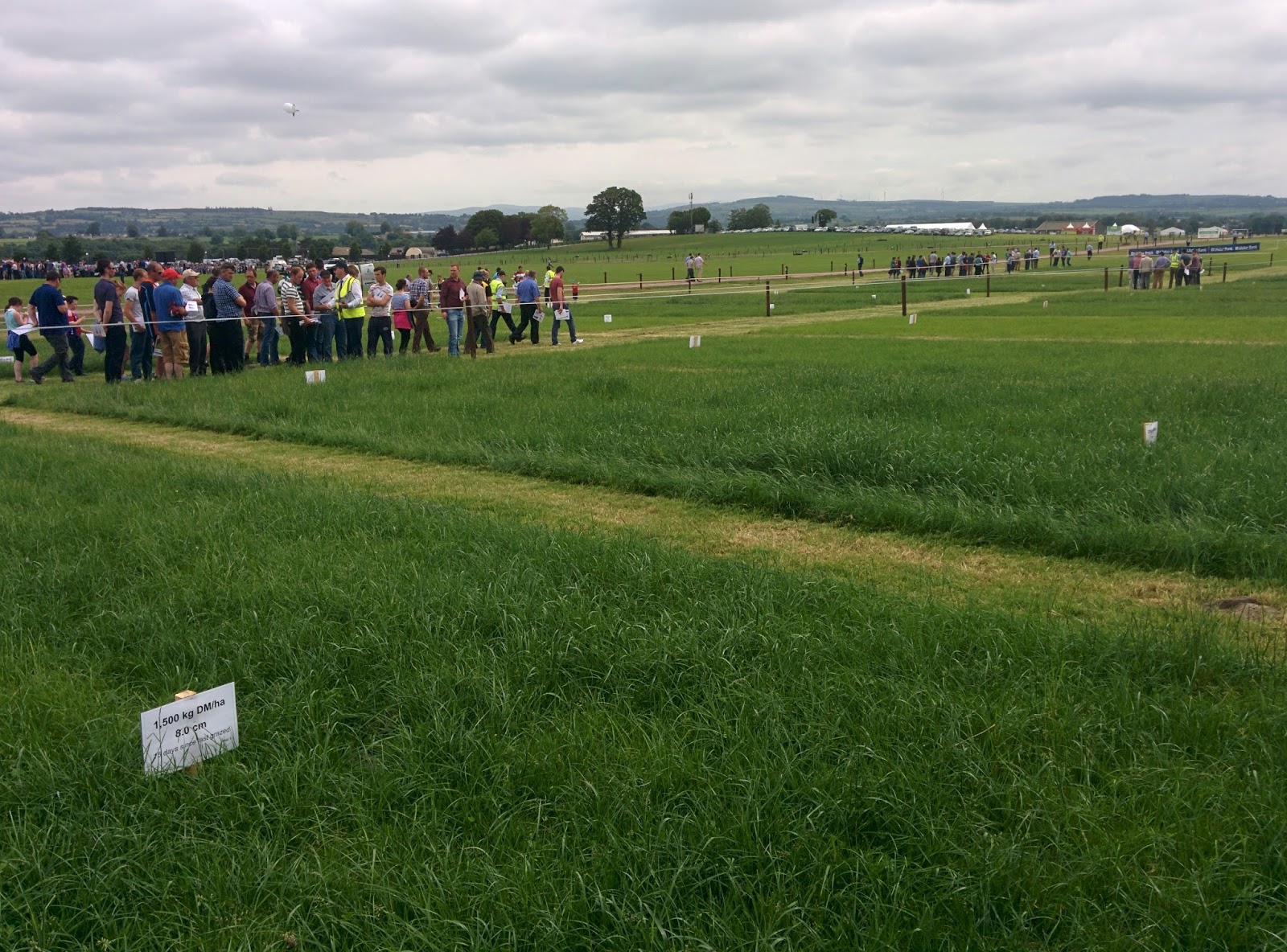
Moorepark Open Day 2015

We began the day in groups listening to the first key speakers, outlining the core messages for the day. With the recent removal of EU milk quotas, sustainable expansion was the overriding theme. What struck me was the smaller scale of dairy farms in Ireland. I'd estimate the average "NZ system" grazing farm in the UK milks close to 300 cows. Whereas in Ireland, where the majority are block calving, the average was 60 cows. Expansion plans also seemed modest with one speaker describing the move from 60 to 80 cows in the future. Whilst these numbers are only the national averages, with many larger and even smaller herds, it emphasises a key difference of scale between UK and Irish units.

A typical information board from the day.

The day was really well organised, with a ridiculous amount of information on offer, covering pretty much every aspect of grassland dairying. It left us wondering why the UK couldn't produce similar research?

In truth the variation in farming systems makes the task of the levy funded research body in the UK a real headache. Ireland's advantage is that they only have to cater to a single grass based audience, whereas the UK has to appease everybody from total confinement operators, to extensive block calving. Fortunately for those of us in the latter camp, Ireland is only a ferry ride away!

Just before I sign off, in a previous post I said I'd share the success or failure of my direct drilled reseeds. Well here's the results ....

Drilled reseeds

Unfortunately the picture doesn't tell the whole story. After a month in the ground the seedlings had germinated and emerged on only about half the ground. We decided to redrill at an angle, which worked straight away. My guess is, there was too much of a compressed matt in the top few inches of soil, this smothered the seeds, and those that did come struggled to root in the hard ground. Only when this matt had rotted away enough was the ground ready for the second drilled seeds to establish. What would I do differently? Maybe try and break the ground and matt with a harrow before drilling. We live and learn in farming!

Saturday, 30 May 2015

Pre Mowing: Recreational diesel use?

Cows tucking in to premown grass back in 2012

Today's post is all about the "sexy" topic of premowing grass for grazing. Just from my own conversations with fellow grazers, it seems the majority have dabbled with premowing at some point, with a range of success. My own opinion is that it's an important tool to help manage grass quality heading into the summer. Others are slightly more sceptical. With this in mind I thought I'd share my tips and thoughts on the practice.

Five years ago we sold our topper and instead bought a mower. This was not to cut silage with, but to specifically premow grass. Topping worked OK, but in some situations the dead grass would lie on the ground and prevent the regrowth shooting through. Here was our justification for the change:

Despite the best management in the world cows will not hit 1500kgDM residuals every time, for a range of reasons, some within our control, others not. Over allocation, inclement weather or just plain bad luck! The decision then is to either try and correct the residual mechanically or hope the cows will graze better 'next time'. The problem is the deck is stacked against us if we use the 'next time' approach. Grazing to 1800kgDM for example, shifts the 'growth point' up to this height, with everything below, low quality, unpalatable stem. At this point we saw premowing as a simple correctional tool to reset the paddock. But what if there were other benefits we hadn't considered?

We soon noticed that when the grass was mown, cows were finishing grazing quicker and lying down full. Then there was the jump in milksolids. Cows went from 1.8 to 1.94kgMS almost overnight. During our surplus months we could now allocate more grass to the cows, knowing they could hoover it up, expending less energy walking the paddock pulling the grass themselves. Capturing the benefits of more feed for less effort.

Costing the exercise is a lot harder. Fuel, labour, repairs and depreciation all have a cost. However, the cost of doing nothing, we have seen time and again, as milk output declined every summer. To this day we now take an aggressive approach to residuals. Any paddock which doesn't meet the standard is put on a list and, weather permitting, will be premown in the next round.

Here are my Dos and Don'ts for those wishing to try it out:
  • Don't mow in a deficit. Mowing slows regrowth, especially when mowing higher covers.
  • Don't mow covers over 3700kgDM. Grass above this cover has lost a lot of its quality and palatability.
  • Don't mow more than 24 hours in advance during dry weather. Grass will overwilt.
  • Do mow 12-24 hours in front of cows. Some wilting will increase the dry matter of grass without losing quality. In very dry weather, the cows can go in straight after mowing.
  • Do mow early in the year. The sooner you can start mowing, the sooner you can stop grass pushing towards heading.
  • Do mow high quality lush grass. The better the grass, the more profound the impact from increased intakes.
  • Do mow low. Use a plate meter to measure your mowed residual, the closer to 1500kgDM the more effective it is.
I hope these helped. Ultimately whether you use a mower, topper, or a second mob of stock to tidy paddocks doesn't matter. The important thing is to recognise poor residuals and remedy them before it's too late!


Tuesday, 5 May 2015

Reseeding 101

Here's a post with a guide to reseeding grass to grass!

Sprayed and drilled pasture at the runoff block.

1. Identify why a paddock needs to be reseeded.

Here, good pasture growth records are vital. 

Paddocks ranked according to TDM/Ha 2014

As we can see in the table, my best paddocks grew over 18T whereas my worst barely grew 10T. With this information I can put my efforts into improving these worst paddocks, for maximum return.

The first thing you can do is asses the condition of the sward. If a paddock contains less than 50% perennial ryegrass then it will likely need a reseed. To identify these grasses pluck some grass and check for the distinctive red colour at the base of the stem. These grasses have the highest performance, both in growth, quality and economic response to fertiliser.

Next I'll consult a recent soil sample. Grants in Wales have enabled us to soil test the entire farm every 3 seasons, at minimal cost. Once the status of the paddock is known I can start correcting any deficiencies in PH, P and K indices.

Now I've decided to reseed I can move onto step 2.

2. Choose an appropriate cultivar: My rant against the seed industry!

There are a myriad of different mixes and grass seed houses selling their wares in the UK. Unfortunately, despite having some of the best cultivar research in the world (IBERS, Aberystwyth), farmers have been badly served by the seed industry. 

Mixes often contain upwards of 6 different varieties, with different characteristics and heading dates. These mixes are a nightmare to manage, with grass heading at different times of year. Worse still the high levels of competition in the sward will mean after the initial establishment year, the more competitive grasses will simply kill off any others. This means your 6 variety mix will end up as a 4 variety ley, with the extra seed a waste of money. 

So why are seed houses pushing these mixes? The answer is to shift old stock. One or two of the varieties may be the latest and greatest seed, but the rest will be bulked out with older, lower performance stock.

My advice is to specify your own mixture, you may be surprised to find it no more expensive than buying off the shelf mixes!

Tetraploid vs Diploid

Tetraploids are more open, erect grasses, that are darker in colour. 
Pros: 
-Higher sugars, with some evidence suggesting they support higher animal performance.
-More open making them more clover friendly
-More palatable leading to lower residuals
-Bigger seeds establish faster in adverse conditions
Cons:  
-Less persistent
-Easier to poach in wet weather
-Easier to overgraze in a drought

Diploids are denser growing, more prostrate grasses, paler than tetraploids.
Pros:
-Denser swards
-More tolerant to poaching
-More tolerant to overgrazing
Cons:
-Less clover friendly
-Slightly less palatable
-Smaller seeds, slower establishment in adverse conditions

Remember tetraploids are more competitive in a sward. If you sow 30% Tet. and 50% Dip., after 3 years the sward will be 50-50.

If this all sounds a bit complicated, sow mainly diploids in wetter areas and mainly tetraploids in drought safe, drier areas. Choose 1-3 varieties with 1-2kg/acre of clover (if you want it). Sow at 14kg/acre for Dip. swards and 17kg/acre for Tet.

The new Irish Pasture Profit Index will help you create your own mix:

3. Choose a reseeding method.

In NZ it is common to spray off the old ley, then direct drill with the new. This simple system can be very cost effective, roughly a third of the cost of cultivating, harrowing and rolling the paddock. It also has benefits in preserving the soil structure (good for worms!) and avoiding plough pans and associated problems. However some caution must be taken before using this technique.

If there is a high level of root mat, common in old permanent pastures, then the old sward will create an acidic environment when it dies off. This can stop germination, resulting in failure. To get round this you can apply lime before drilling. However in some cases it won't be enough. In this case some sort of cultivation is required to break up the mat before sowing.

Grass emerging in the drill rows.

This year we've taken the risk and sprayed off the old permanent pasture, limed and drilled, with no cultivation. As you can see in the image above the seeds have germinated OK, coming much quicker in the open parts of the paddock where the old mat isn't shading the seedlings. I'm crossing my fingers it will work, but am already regretting not running a harrow over the field to open the sward more before drilling. If I feel brave I'll post another picture in a months time so you can see our success/failure!

I hope this has helped, establishing grass can seem very complicated and often a bit of luck can make all the difference!

Sunday, 26 April 2015

Peak Milk: Flat rate feeding systems

Cows grazing paddock 26, sown with AberGain.

We've had a week of very warm weather. Growth was recorded at 60 on Monday, but with some much needed rain forecast, hopefully it will have overtaken demand, which is running closer to 70.

Cows are down to 1kg a day of meal in the parlour, just enough to maintain a steady cowflow in the dairy. Despite cutting out the meal, milk output hasn't dropped, with cows giving 2.1kgMS. One thing we've noticed, however, is that with the good weather and our fast rotation, there is very little stem in the base of the sward. This is the equivalent of feeding more of the "concentrate", leafy, part of the grass plant, with high energy and protein, but low structural fibre. Butterfats are very low, at 3.55%, but volumes are very high at 29.5 litres. 

So the question is should we be feeding more of a high fibre meal to redress this balance?

In short I'd say no. Especially with this years' milk prices. With this in mind I thought I'd discuss an alternative approach.

A lot of UK seasonal calvers have adopted a flat rate feeding approach. Cows are fed the same amount of meal , typically 3-4kg/cow, everyday of lactation, essentially fixing demand. Here are some pros and cons of this system:

Pros:
-Very easy to budget meal costs.
-Easy for staff, less decision making.
-Efficient way of administering minerals.
-Consistent part of diet for cows.
-Can protect milk income from vagaries of grass quality and weather.

Cons:
-Unable to capitalise on a "good growing year", where high grass growth leads to lower meal costs.
-Surplus growth can only be captured as silage.
-Without an appropriate stocking rate the points above can be exacerbated.

In our own position flat rate feeding doesn't add up. This is because we already make enough silage on our runoff block. Any silage made from the platform is a management headache, as we prefer to keep the whole grazing block in our rotation, challenging cows to eat as much cheap, high quality grass as possible.

Whatever approach you take to supplement feeding the important questions to ask are:
1) Why am I feeding?
2) From a whole systems approach, does it pay?

Until next time, keep grazing!
Emlyn

Friday, 10 April 2015

Magic Day at last!

Just a quick post to mark the passing of Magic Day, where grass growth overtakes demand. My guess was it was sometime last week.

It hasn't been a vintage Spring, with growth generally below average for much of March. But there's nothing like a good April to cheer us up!

April scenes at Tre Abbot

As you can make out in the picture, we've done our reseeding this week. 
I'll have to write a separate post on reseeding, but until then here's the brief:

This years mix/per acre is, AberGain 7Kg, AberChoice 7Kg and AberHerald clover 2Kg.

For more information on grass varieties check out the new Irish Pasture Profit Index: 

I hope you're all enjoying the weather, and until next time, keep grazing!
Emlyn

Saturday, 4 April 2015

Pre Mating Part 1: Get your calendar out!

As we approach our spring PSM (planned start of mating) I thought I'd write a post about the pre-mating work we do, and why this is one of the most time critical parts of the year!

It seems a bit relentless, but as soon as calving comes to an end, we're already thinking of next season and getting them back in calf. The main tasks can be divided into the following:

1) Heifer mating - Whether you plan to AI or turn the bulls in, now is the perfect time to weigh your maiden heifers to see if they're going to meet target weights to bull. While we have them in the handling yard we like to make the most of the time, so we've been vaccinating, trimming tails, worming and giving them a mineral bolus. Their final weigh-in will be next week. This year anything below 10% of target will be ran with the bulls from Day 1, with the rest getting a fixed time AI. I'm hoping that at least 100/140 will be heavy enough.

2) Pre-mating heats - The past three seasons we have tail painted the heard 42 days before PSM and recorded pre-mating heats. These have helped us get a picture of cows activity which we can consult throughout mating, in case we've missed heats or to spot cystic cows which tend to have very short, frequent cycles.

3) Metricheck and treat - The whole herd has been metrichecked, with cows showing endometritis or "whites", marked and treat accordingly. This is now a weekly practise, with this "dirty" group checked once a week and any non cyclers rechecked during milking. This may seem like overkill, but the key is that I check and treat the cows myself instead of the cost and hassle of calling the vet out.

Metricheck devices are available in the UK, and are an invaluable tool for quick diagnosis in block calving herds.

Treatment then falls into three categories, in order of severity from OK to worst, they are:
1) Washout with a dilute iodine solution, we use pevidine scrub.
2) Metricure antibiotic, no milk withhold.
3) 4 days course of antibiotics, milk withheld, we use Pen & Strep.

April is always a busy month, but the sooner we can set our breeding animals up for mating, the greater our chances of success. Relatively cheap solutions now, can have a huge impact on your eventual performance, as we strive for the virtuous circle of fertility.

In Part 2 I'll discuss the hot topic of intervention, CIDRs, estrumate and the rest!


Wednesday, 18 March 2015

Calf Rearing: Laborious fun!

Today's post is all about rearing calves. Undoubtedly the most labour intensive task at this time of year!
Calf rearing at Tre Abbot

Now to start off I think I should admit I'm not an expert calf rearer. We run a simple system that suits our facilities and circumstances. There are many ways to rear calves and ultimately if you're happy with your calves and eventual heifers, then you're doing something right!

What I would say, however, is that I've seen calf rearing go wrong and have had to learn quickly which things can have the biggest positive effect on stock-person and animal.

With this in mind, here are my ground rules for calving in order of importance:

1) Colostrum: Every heifer calf is stomach tubed with 4 litres of colostrum within 6 hours of birth. Bulls with 2.5 litres. This is singly the most important thing you can do to improve calf health and mortality rates. Some may prefer to bottle feed, we stomach tube to keep the protocol easy and consistent for staff.

2) Cleanliness: Calves should always have clean bedding, clean forage to pick at, and if fed once a day, clean water to drink. This seems obvious, but fulfilling these requirements first requires good facilities. In the picture above you can see we use our silage clamp to house the calves. Straw bales are used to divide pens, encouraging calves to eat the clean straw walls, instead of soiled bedding. This space also provides good drainage and ease of access for bedding and feeding. In the past I've wasted a lot of time and energy trying to keep substandard pens clean.

3) Static groups: Calves should be grouped with similar aged animals, and not moved from their starting pen. It may be tempting to identify a "slow drinker" early on, and move it to a different group. But in doing so you run a risk. If that calf is burdened by something contagious, like scours or pneumonia, then you can quickly end up transferring this problem to a new group. We prefer to persevere with "slow" calves, and invariably they will eventually catch up.

Their are many other rules I could add to this list, but these are the essentials. My goal is to turn a fragile, milk dependant calf, into a cheap to keep weanling capable of growing well on grass. With this in mind here is a description of our rearing system:

Ad-lib concentrates with a coccidiostat offered throughout.

Day 0: 4L of colostrum
Day 1-10: 2.5L twice a day of whole milk
Day 11-Weaning*: 2.5L once a day, 500g CMR

*Calves can be weaned at 65Kg for a Friesian, but should be kept on ad-lib concentrates and straw until 85Kg.

Start weighing calves from 6 weeks old, if you can weigh a sample once a week it will have the added bonus of encouraging staff, as they can quantify their progress and see that "the end is in sight"
Weighing this week has shown calves are growing at 1Kg/day, with the eldest group consuming 1.5Kg/day of concentrates.

Every herd will have its own challenges and health status. But I'm a great believer that keeping things simple and repeatable will give consistent results!

Emlyn


Wednesday, 4 March 2015

Residuals


Pre (3400KgDM) and Post (1400KgDM) Grazing heights in paddock 4

Grazing conditions have been excellent for the last 4 days. Cold winds have dried the farm, allowing cows to graze paddocks very well. Judging by the post grazing height, almost too well.

The two most important grazing rounds are the first and the last. In the first we try and graze out all the old winter growth, and the earlier we do this the better. Over winter grass enters a dormant phase where growth slows to a minimum, grass drymatter will increase, but overall herbage mass is static. Defoliation wakes the plant from this state and kick starts growth. Low residuals in the first round are particularly important, as any dead-matter in the sward is removed, maximising future growth and quality for subsequent rounds. If ever there was a time to treat cows a little meaner and graze harder, now is that time.

The exception to this rule is the above scenario, where residuals are under 1500KgDM. Here supplementing your grass with concentrates (or whatever you have locally) will have a high milk response and higher profitability than the decision to feed at other times. This is because:

1.) Cows grazing below 1500KgDM are telling you they are close to being underfed, they are close to their physical limit of grass utilisation. It stands to reason then, that feeding them more of a high quality feed will suddenly provide them with a higher net energy(ME) intake, and increase milk production.

2.) Lifting residuals to above 1500KgDM will result in faster regrowth as the grass is left with a higher reserve of sugars, from which to grow.

So this weeks grazing decision is obviously to supplement the grazing. Cows are being fed 4Kg of a 13ME, 14% Protein concentrate, along with roughly 1KgDM of average quality silage (10.5ME).

In a future post I'll discus energy intakes for grazing cattle, and how to think of grass purely as an energy source!

Thursday, 26 February 2015

1000 Visits!

Just a short post today to let you all know the blog has passed 1000 page visits!

Table showing page visits by nation

Thanks to everyone who has stopped by, and for all the positive feedback I've received in the last month.

I hope to post at least fortnightly throughout the year, and try to cover as many topics as I can. I've tried to steer it away from being over technical and wonkish, to provide a broader appeal. But if more detail and figures are what you're after then here is a list of sites/sources I love to read and trawl:

http://www.agresearch.teagasc.ie/moorepark/
The Irish research farm Moorepark provides a fantastic starting point for pretty much any topic concerning grass based systems.

http://www.siddc.org.nz/lu-dairy-farm/
Lincoln University Dairy Farm, based in Canterbury, NZ. Check out their 'Focus Day' handouts, providing a wealth of information, and demonstrating just how much can be recorded and analysed on a farm.

http://side.org.nz/past-proceedings/
Past proceedings from the annual South Island Dairy Event in NZ. A huge number of topics are covered. One of the first sites I came across, and still keeping me occupied for hours!

http://www.dairynz.co.nz/
DairyNZ's website, particularly useful is the NZAEL section, which provides proofs for bulls based on BW.

I hope these sites prove as useful to you as they have been to myself.

Until next time, good luck and keep grazing!

Emlyn

Saturday, 14 February 2015

Staffing your Seasonal Unit

In today's post I thought I'd discuss staffing on seasonal calving farms.

On an unrelated note, here's a recent picture of my 1 year old heifers, just to hold your interest:

Heifers cell grazing

As a spring calver I like to think I work twice as hard for half the year, then half as hard for the rest! Almost all the important, labour intensive tasks are focussed in the first six months of the year. We calve for 10 weeks, then we're straight into our DIY AI for another 6-8 weeks, before we can turn the bulls in and have a rest.

This all works OK(ish) with owner operators and equity/sharefarmers. We can work from Feb to mid April without a cow free day, including weekends. But really is this just a failure of our own management?

I recently heard that the goal of management was to make yourself redundant. I don't wholly agree with this, but it's an interesting point. One of the markers of the success of our management is how well things run in our absence. By this measure if I feel I can't take a day away from my farm for 70+ days, this would seem quite a failure.

But is seasonal calving a special case, that doesn't necessarily compare to other industries and wider management practises? At least one experienced person needs to be available round the clock, unless staff are onsite, which is rarely the case for small/medium operators in the UK, then this will fall to whoever lives in the farm house.

The other problem is that there is not an abundance of semi experienced causal labour that can be fairly employed for the 3-4 busiest months. We face the choice of either over staffing for the entire year, or under staffing, grinning and baring it. Perhaps the answer is somewhere in between? 

We've recently taken on a relief milker for the morning milkings. So far it's working well, freeing up an extra pair of hands to either help with calf rearing or training heifers in the parlour. We've calved 33% in 14 days and so far we seem to be coping. I doubt I'll manage many more cow free days, but with my wife expecting our first child on April 11th hopefully I'll be forced to relax, manage better and spend as many days as I can getting to know my new baby daughter. Because ultimately those will prove the most important and memorable days of my whole seasonal calving calendar!

Emlyn 

Tuesday, 3 February 2015

Let's go grazing!

Just a short post to mark the start of grazing at Tre Abbot.

Cows grazing paddock 9

Barring any extreme weather events, like the snow of Spring 2013, milkers will be out grazing day and night until the last week of November. Ground conditions are good at the moment, with cold winds drying the farm for the last 3 days.


Grazing Wedge 01/02/15

Figures about the weeks grazing:

Average Cover: 2500
Growth: 3.5*
Demand: 3.5
Rotation Length: 120
Allocation per day Ha: 0.88
LU/Ha: 0.5
Supplements Kg: 3 Concentrate, 2 Silage

* First measurement since November, so read this as average winter growth.


Sunday, 1 February 2015

Calving 2015: A promising start

Things have finally kicked off on both our farms now!

Cows wintered at the runoff are bagging up, with a wagon booked for next week, to start bringing them home on the point of calving. Hopefully two loads a week, plus our own trailer everyday, will help us keep ahead of the game (famous last words)!

The big news though has been the success of our heifer synchrony programme.

Today, 1st of Feb, is the PSC (planned start of calving) for our heifers with the cows expected from the 10th.

Over the last five days we have calved 12% of the herd, nearly all heifers! Our heifers were synchronised and all served on the same day to an easy calving sire. To have 50% of them calved by their due date, with another 25%-30% bagged up, and expected in the next few days is really pleasing for several reasons:

1. Staff are fresh from our winter break, so we are most able to deal with any calving problems and training heifers in the parlour. Though with a daughter proven, easy calving sire, we have only had to assist one birth so far (touch wood).

2. These animals will have the maximum amount of time to recover from calving and cycle before our mating start date.

3. High BW heifer calves born at the start of our block means they will have the maximum time to grow and meet target weights for breeding.

Here's hoping that calving continues apace. My next post will probably be a bit about calf rearing, with lots of cute pictures.

Until then, best of luck to everyone calving, or thinking about turning cows out to graze!

Emlyn