Monday, 12 October 2015

Autumnal Grazing

Cows off to graze on a brisk morning.

Today's post will be about autumn grazing management.

Things are going well at Tre Abbot. Autumn has been very kind so far. From a poor start, with a cold and miserable August, it has soon turned out to be a fantastic period for grass and cows. Where we had budgeted growth in the 40s, instead we've had almost a fortnight growing at 60+kgDM/Ha/Day. Along with this the weather has stayed dry, allowing for very clean residuals.

Just to emphasise the point, and to prove I don't just take pictures of cows and grass, here's my 6 months old in the garden.

Mari enjoying the warm weather!

So at this time of year the grazing is simplified using an autumn rotation planner. Basically in this, our final round, we aim to graze 60% of the farm in October and 40% in November. Knowing the farm has little to no winter growth, and that we have a very high spring demand, we will aim to finish grazing with a cover of 2200kgDM/Ha. Grazing management has become offering the cows the same allocation every day, and supplementing the difference. Along with the rotation planner we use an autumn budget so we know how much grass should be on the farm each week until drying off.

Autumn Budget

As you can see, despite a poor start, growth has been exceptional and leaves us just ahead of budget going into this week. Both the autumn rotation planner and the budget are very simple tools that we have used for over ten years now. Not trying to reinvent the wheel, and sticking to tried and tested grazing management has led to very consistent and replicable results.

R1s happy on the break.

On a personal note, in the past couple of months I've taken on work as a grazing consultant. So far I've really enjoyed the experience working with some interesting and varied clients. Being put on the spot and challenged to provide advice has really helped firm my own values around resilient grass based systems and the positive effects grazing can have for man and beast alike! My current plans are to keep it to two visits a week.

Until next time, keep grazing!

Sunday, 30 August 2015

Results Day: Scanning 2015

Just a quick blog post today to update you all on what's been happening on farm.

At this time of year we look to build farm cover by extending the grazing round. We build up a bank of grass to keep us grazing until drying off at the end of November. Unfortunately, temperatures have been below average, as has rainfall. This has meant feeding silage a month earlier than planned. But in the last fortnight we finally had significant rain, and covers are now back on target.

Getting ready to scan some heifers!

The other news this month are our scanning results. This year, cows were mated for 12 weeks, 6 weeks of AI and 6 weeks of stock bulls. Heifers all had a single fixed timed AI then ran with Jersey bulls for 12 weeks.

As our favourite vet, "Kiwi" Kate Burnby, was only in the area for a few days, we decided to bite the bullet and scan all 370 cows and 140 heifers in one day. We started in the morning scanning on the vet platform as the cows are milked on the rotary parlour. Kate is so fast at this that the whole process barely added half an hour to our milking time!

The great news was that for the third season in a row only 7% of our cows were empty. With 83% in calf to the 6 week AI.

After some toast and a mug of tea, we set off to the runoff block to scan the R2s. We've never scanned R2s before, but given our surplus of stock we thought it would at least give us the option to sell some. Despite my reservations that these were a smaller group of heifers than the year before, we only found 5% empty (7 heifers), with 84% in the first 6 weeks. We won't know how well they have held to the AI, but Kate seemed confident that a lot of them would be early calving.

We're obviously really pleased with all the results and are now faced with many options for next season. Here are just a few:
1. Keep everything and milk more cows
2. Sell surplus heifers
3. Sell surplus cows
4. Clean out herd with more voluntary culling

Whilst I'm considering all of these, I'd rather not winter any stock I don't intend to keep and milk myself next season. But at the end of the day it's great to have a choice.

Before I sign off  just a quick thanks  to Clawdd Offa for letting us borrow Sue for the day! She was a massive help and it's fair to say we couldn't have managed without her. And of course thanks to Kate for a professional and efficient scanning.

Until next time,
Keep grazing!

Monday, 10 August 2015

Cutting Costs


So here it is. A simple graph illustrating milk price volatility in the last ten years. Dairy farmers worldwide will be acutely aware of where we are today. Everyone has a slightly different story of how we've ended up in this mess, from the Russian ban on EU imports, to Chinese over purchasing. I'm not going to wade in on the causalities, only to say they are many, complex and often interlinked. Instead I've chosen to focus on what I can control: my own cost of production.

The biggest advantage of a seasonal calving, grass based system, is the low cost per KG of milk which can be achieved. With grazed grass the cheapest feed available, matching cow demand to grass growth helps to not only insulate us from the volatility of purchased feed costs, but also to avoid the "hidden" costs of wastage, substitution and depreciation. From these core values of grass utilisation and production costs, I sat down today and wrote out the key areas in which I could cut costs next season.

Are you carrying surplus animals?

  • Carry fewer surplus animals. This is probably the single biggest place I can save money. Scan cows early and cull/sell anything you don't intend to milk next season. Wintering is a big costs for an animal that you won't milk the next season. We would usually keep some late calvers and sell to them into the UK, year round calving, market. Unfortunately I don't think there will be a big market for these animals in a low milk price year.
  • Use Stock Bulls on our bulling heifers. Despite our success with AI over the past two seasons, it is still a cost which can be saved from our cash flows. Any herd expansion plans will be put on hold in light of the milk price, so the cost of fewer AI bred replacements can be mitigated. This leads on to my second point...
  • Less intervention in the main herd. For the past three seasons we have used CIDRs on all +42 day calved cows, which haven't cycled premating. Despite averaging a respectable 56% conception, the numbers we have to treat have fallen as the herd quality has improved. With a surplus of R1s, it is now time to "mine" this core fertility and trust we will get enough replacements without the 5-7% CIDR cows.
  • Delay repairs and cut capital expenditure. In any other year I'd love to upgrade some of our tracks and purchase a better handling facility for our youngstock. But these will have to wait. We have invested a lot in recent years, upgrading everything from the parlour to water system. Now it's time to put the chequebook away and focus on making the most out of what we have.
  • Reduce regrassing. Typically we would look to reseed 10% of the milking platform a year. However this could be reduced to 5% or less for the coming season. Apart from the immediate savings in seed and contracting, it would also act as insurance against inclement weather which would otherwise force us to purchase more feed.
Hopefully these suggestions have given you all some food for thought about your own on farm costs. Exceptionally low milk prices will call for a degree of short termism, which may not sit comfortably with our long term goals. But when the battle is right in front of us, the real victory will be if we're still around to farm the year after! 

Saturday, 18 July 2015

Spreading the good word of Grazing!

Firstly, apologies for such a late blog post. I do try and update once a fortnight. But in my defence it's been a particularly busy month.

Mid summer is a great time to get off our own farms and get out of the daily bubble.

To start off, we've had a great trip to Pembrokeshire to see the in-laws, and to show our four month old daughter the beautiful beaches for the first time. Fortunately she slept most of the four hour journey there, and was in a good mood for the whole trip!

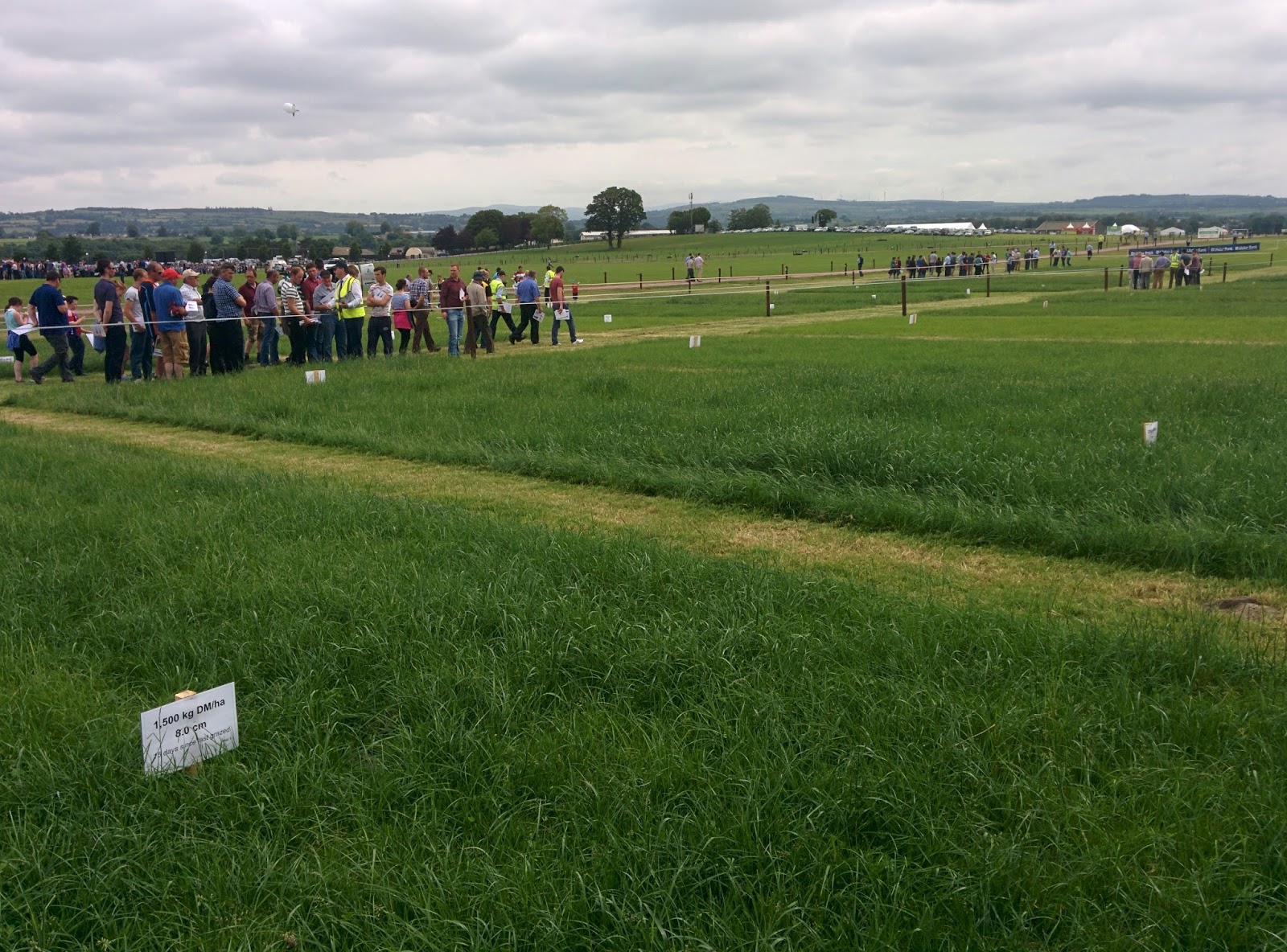
More recently I've been to Ireland, to visit Moorepark for their open day. With a fantastic turnout of over 14000 people, it's fair to say Irish farmers are positive about grassland farming!

Moorepark Open Day 2015

We began the day in groups listening to the first key speakers, outlining the core messages for the day. With the recent removal of EU milk quotas, sustainable expansion was the overriding theme. What struck me was the smaller scale of dairy farms in Ireland. I'd estimate the average "NZ system" grazing farm in the UK milks close to 300 cows. Whereas in Ireland, where the majority are block calving, the average was 60 cows. Expansion plans also seemed modest with one speaker describing the move from 60 to 80 cows in the future. Whilst these numbers are only the national averages, with many larger and even smaller herds, it emphasises a key difference of scale between UK and Irish units.

A typical information board from the day.

The day was really well organised, with a ridiculous amount of information on offer, covering pretty much every aspect of grassland dairying. It left us wondering why the UK couldn't produce similar research?

In truth the variation in farming systems makes the task of the levy funded research body in the UK a real headache. Ireland's advantage is that they only have to cater to a single grass based audience, whereas the UK has to appease everybody from total confinement operators, to extensive block calving. Fortunately for those of us in the latter camp, Ireland is only a ferry ride away!

Just before I sign off, in a previous post I said I'd share the success or failure of my direct drilled reseeds. Well here's the results ....

Drilled reseeds

Unfortunately the picture doesn't tell the whole story. After a month in the ground the seedlings had germinated and emerged on only about half the ground. We decided to redrill at an angle, which worked straight away. My guess is, there was too much of a compressed matt in the top few inches of soil, this smothered the seeds, and those that did come struggled to root in the hard ground. Only when this matt had rotted away enough was the ground ready for the second drilled seeds to establish. What would I do differently? Maybe try and break the ground and matt with a harrow before drilling. We live and learn in farming!

Saturday, 30 May 2015

Pre Mowing: Recreational diesel use?

Cows tucking in to premown grass back in 2012

Today's post is all about the "sexy" topic of premowing grass for grazing. Just from my own conversations with fellow grazers, it seems the majority have dabbled with premowing at some point, with a range of success. My own opinion is that it's an important tool to help manage grass quality heading into the summer. Others are slightly more sceptical. With this in mind I thought I'd share my tips and thoughts on the practice.

Five years ago we sold our topper and instead bought a mower. This was not to cut silage with, but to specifically premow grass. Topping worked OK, but in some situations the dead grass would lie on the ground and prevent the regrowth shooting through. Here was our justification for the change:

Despite the best management in the world cows will not hit 1500kgDM residuals every time, for a range of reasons, some within our control, others not. Over allocation, inclement weather or just plain bad luck! The decision then is to either try and correct the residual mechanically or hope the cows will graze better 'next time'. The problem is the deck is stacked against us if we use the 'next time' approach. Grazing to 1800kgDM for example, shifts the 'growth point' up to this height, with everything below, low quality, unpalatable stem. At this point we saw premowing as a simple correctional tool to reset the paddock. But what if there were other benefits we hadn't considered?

We soon noticed that when the grass was mown, cows were finishing grazing quicker and lying down full. Then there was the jump in milksolids. Cows went from 1.8 to 1.94kgMS almost overnight. During our surplus months we could now allocate more grass to the cows, knowing they could hoover it up, expending less energy walking the paddock pulling the grass themselves. Capturing the benefits of more feed for less effort.

Costing the exercise is a lot harder. Fuel, labour, repairs and depreciation all have a cost. However, the cost of doing nothing, we have seen time and again, as milk output declined every summer. To this day we now take an aggressive approach to residuals. Any paddock which doesn't meet the standard is put on a list and, weather permitting, will be premown in the next round.

Here are my Dos and Don'ts for those wishing to try it out:
  • Don't mow in a deficit. Mowing slows regrowth, especially when mowing higher covers.
  • Don't mow covers over 3700kgDM. Grass above this cover has lost a lot of its quality and palatability.
  • Don't mow more than 24 hours in advance during dry weather. Grass will overwilt.
  • Do mow 12-24 hours in front of cows. Some wilting will increase the dry matter of grass without losing quality. In very dry weather, the cows can go in straight after mowing.
  • Do mow early in the year. The sooner you can start mowing, the sooner you can stop grass pushing towards heading.
  • Do mow high quality lush grass. The better the grass, the more profound the impact from increased intakes.
  • Do mow low. Use a plate meter to measure your mowed residual, the closer to 1500kgDM the more effective it is.
I hope these helped. Ultimately whether you use a mower, topper, or a second mob of stock to tidy paddocks doesn't matter. The important thing is to recognise poor residuals and remedy them before it's too late!


Tuesday, 5 May 2015

Reseeding 101

Here's a post with a guide to reseeding grass to grass!

Sprayed and drilled pasture at the runoff block.

1. Identify why a paddock needs to be reseeded.

Here, good pasture growth records are vital. 

Paddocks ranked according to TDM/Ha 2014

As we can see in the table, my best paddocks grew over 18T whereas my worst barely grew 10T. With this information I can put my efforts into improving these worst paddocks, for maximum return.

The first thing you can do is asses the condition of the sward. If a paddock contains less than 50% perennial ryegrass then it will likely need a reseed. To identify these grasses pluck some grass and check for the distinctive red colour at the base of the stem. These grasses have the highest performance, both in growth, quality and economic response to fertiliser.

Next I'll consult a recent soil sample. Grants in Wales have enabled us to soil test the entire farm every 3 seasons, at minimal cost. Once the status of the paddock is known I can start correcting any deficiencies in PH, P and K indices.

Now I've decided to reseed I can move onto step 2.

2. Choose an appropriate cultivar: My rant against the seed industry!

There are a myriad of different mixes and grass seed houses selling their wares in the UK. Unfortunately, despite having some of the best cultivar research in the world (IBERS, Aberystwyth), farmers have been badly served by the seed industry. 

Mixes often contain upwards of 6 different varieties, with different characteristics and heading dates. These mixes are a nightmare to manage, with grass heading at different times of year. Worse still the high levels of competition in the sward will mean after the initial establishment year, the more competitive grasses will simply kill off any others. This means your 6 variety mix will end up as a 4 variety ley, with the extra seed a waste of money. 

So why are seed houses pushing these mixes? The answer is to shift old stock. One or two of the varieties may be the latest and greatest seed, but the rest will be bulked out with older, lower performance stock.

My advice is to specify your own mixture, you may be surprised to find it no more expensive than buying off the shelf mixes!

Tetraploid vs Diploid

Tetraploids are more open, erect grasses, that are darker in colour. 
Pros: 
-Higher sugars, with some evidence suggesting they support higher animal performance.
-More open making them more clover friendly
-More palatable leading to lower residuals
-Bigger seeds establish faster in adverse conditions
Cons:  
-Less persistent
-Easier to poach in wet weather
-Easier to overgraze in a drought

Diploids are denser growing, more prostrate grasses, paler than tetraploids.
Pros:
-Denser swards
-More tolerant to poaching
-More tolerant to overgrazing
Cons:
-Less clover friendly
-Slightly less palatable
-Smaller seeds, slower establishment in adverse conditions

Remember tetraploids are more competitive in a sward. If you sow 30% Tet. and 50% Dip., after 3 years the sward will be 50-50.

If this all sounds a bit complicated, sow mainly diploids in wetter areas and mainly tetraploids in drought safe, drier areas. Choose 1-3 varieties with 1-2kg/acre of clover (if you want it). Sow at 14kg/acre for Dip. swards and 17kg/acre for Tet.

The new Irish Pasture Profit Index will help you create your own mix:

3. Choose a reseeding method.

In NZ it is common to spray off the old ley, then direct drill with the new. This simple system can be very cost effective, roughly a third of the cost of cultivating, harrowing and rolling the paddock. It also has benefits in preserving the soil structure (good for worms!) and avoiding plough pans and associated problems. However some caution must be taken before using this technique.

If there is a high level of root mat, common in old permanent pastures, then the old sward will create an acidic environment when it dies off. This can stop germination, resulting in failure. To get round this you can apply lime before drilling. However in some cases it won't be enough. In this case some sort of cultivation is required to break up the mat before sowing.

Grass emerging in the drill rows.

This year we've taken the risk and sprayed off the old permanent pasture, limed and drilled, with no cultivation. As you can see in the image above the seeds have germinated OK, coming much quicker in the open parts of the paddock where the old mat isn't shading the seedlings. I'm crossing my fingers it will work, but am already regretting not running a harrow over the field to open the sward more before drilling. If I feel brave I'll post another picture in a months time so you can see our success/failure!

I hope this has helped, establishing grass can seem very complicated and often a bit of luck can make all the difference!

Sunday, 26 April 2015

Peak Milk: Flat rate feeding systems

Cows grazing paddock 26, sown with AberGain.

We've had a week of very warm weather. Growth was recorded at 60 on Monday, but with some much needed rain forecast, hopefully it will have overtaken demand, which is running closer to 70.

Cows are down to 1kg a day of meal in the parlour, just enough to maintain a steady cowflow in the dairy. Despite cutting out the meal, milk output hasn't dropped, with cows giving 2.1kgMS. One thing we've noticed, however, is that with the good weather and our fast rotation, there is very little stem in the base of the sward. This is the equivalent of feeding more of the "concentrate", leafy, part of the grass plant, with high energy and protein, but low structural fibre. Butterfats are very low, at 3.55%, but volumes are very high at 29.5 litres. 

So the question is should we be feeding more of a high fibre meal to redress this balance?

In short I'd say no. Especially with this years' milk prices. With this in mind I thought I'd discuss an alternative approach.

A lot of UK seasonal calvers have adopted a flat rate feeding approach. Cows are fed the same amount of meal , typically 3-4kg/cow, everyday of lactation, essentially fixing demand. Here are some pros and cons of this system:

Pros:
-Very easy to budget meal costs.
-Easy for staff, less decision making.
-Efficient way of administering minerals.
-Consistent part of diet for cows.
-Can protect milk income from vagaries of grass quality and weather.

Cons:
-Unable to capitalise on a "good growing year", where high grass growth leads to lower meal costs.
-Surplus growth can only be captured as silage.
-Without an appropriate stocking rate the points above can be exacerbated.

In our own position flat rate feeding doesn't add up. This is because we already make enough silage on our runoff block. Any silage made from the platform is a management headache, as we prefer to keep the whole grazing block in our rotation, challenging cows to eat as much cheap, high quality grass as possible.

Whatever approach you take to supplement feeding the important questions to ask are:
1) Why am I feeding?
2) From a whole systems approach, does it pay?

Until next time, keep grazing!
Emlyn